Hasbro G0351 English edition, 110 cards, 2–5 players. In this leaflet a Just Say No played during your own turn counts toward your three cards; houses and hotels are discarded if their set becomes incomplete. Do not silently substitute other editions' FAQs.
- Players
- 2–5 (Hasbro G0351)
- Cards & equipment
- Monopoly Deal deck (110 cards in G0351)
Monopoly Deal rules for the Hasbro G0351 edition
Monopoly Deal is a separate card game, without a board, dice or moving tokens. This guide follows Hasbro's G0351 English game guide for two to five players. Its 110-card deck contains properties, wild properties, money and actions, including reference cards removed during setup.
Win by collecting three complete property sets in three different colors. Two red sets and a blue set do not qualify. Read each property's printed set size: three cards do not complete every color, and money in the Bank never substitutes for a missing property. This is a collection race, not a contest to have the most money when a timer expires. Special themed editions and older instructions may differ, so check the product code on your guide.
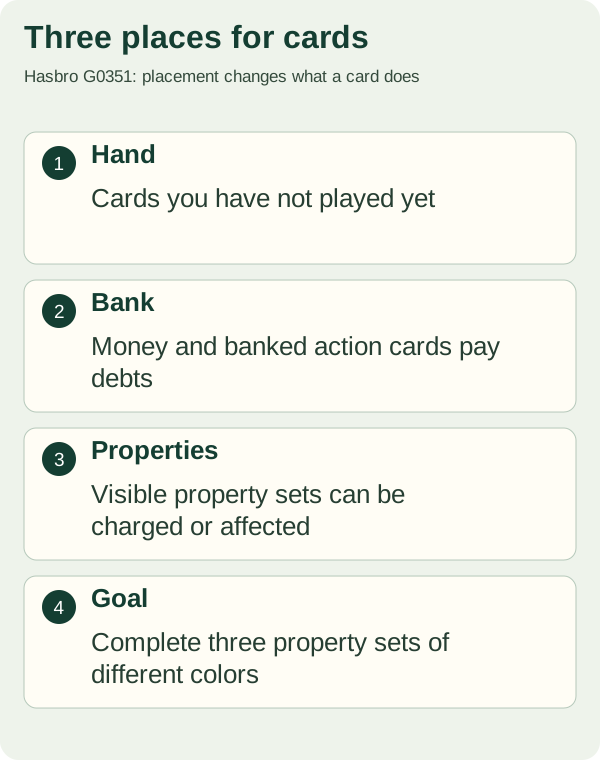
Set up a hand, Bank and property collection
Remove the reference cards, give one to each player and return spares to the box. Shuffle the remaining deck and deal five cards privately to everyone. Put the rest face down as the draw pile, leaving space for a face-up discard pile. The youngest player goes first, with turns passing left.
In front of each player, keep the Bank separate from the property collection. Money and action cards can be banked; properties cannot. An action card placed in the Bank becomes money at its printed value, losing its action use. It cannot later be picked up and used as an action. Keeping these areas visibly apart prevents a frequent error: counting banked cards as properties or treating a valuable property as spare cash already in the Bank.
Draw, make up to three plays and check your hand
Begin your turn by drawing two cards. If your hand is empty at the start of the turn, draw five instead, not five plus two. Then play up to three cards; playing none is allowed. Each banked card, new property or action is a card played. Once played, a card cannot return to your hand.
For example, bank a money card, place a property and play a rent action: that uses all three plays. You cannot add a fourth property because the first two cards were not actions. Emptying your hand during the turn does not immediately trigger another five-card draw. At the end, discard down to seven hand cards if necessary. The seven-card limit applies to the hand, not to your Bank or collection.
Monopoly Deal payments: Bank, property and no change
You choose how to pay, rather than letting the creditor choose your cards. Use eligible cards from your Bank or property collection, never from your hand. Money and banked actions go into the recipient's Bank; properties go into their property collection. If the Bank cannot cover what you owe, properties must be used too. If everything available is insufficient, pay what you can; having nothing on the table means nothing can be collected.
There is no change. Suppose you owe two money units and have only a five-unit bank card, with no properties. Hand over that card and receive nothing back. If instead you hold only cards privately in your hand, those cards do not pay the debt. The printed values are game money, not real currency. Do not use property rent values as their debt-payment values; the property card separately identifies its monetary value.
Wild-property rules: new cards versus color changes
In Monopoly Deal, playing a new wild property from your hand uses a card play, just like placing another property. Changing the color of a wild already on the table during your own turn does not use another play. A two-color wild represents one of its displayed colors; orient it to show your choice. Keep wild properties out of the Bank and do not overfill a set, although you may start another set of the same color.
For example, moving an existing wild from one incomplete set to another may complete the second while reopening the first. Count the final sets, rather than both layouts at once. An every-color wild has no money use and cannot make a complete set entirely from those every-color wilds alone. Do not generalize that restriction into an invented ban on every possible combination of two-color wilds. Keep each physical card assigned to one set at a time.
Read rent, buildings and Just Say No carefully
Rent is collected by playing a rent action, using an allowed color and the amount for the properties you currently own in that set. Follow the card for who pays. Double the Rent is played with a rent action and itself uses one of the three plays. A rent card plus one doubler therefore uses two plays.
Houses and hotels attach only to complete sets, excluding railroads and utilities. A hotel needs a house already on that set; keep the house too. Only one of each is allowed per set. Under G0351, discard those buildings if the set becomes incomplete. They can also be used to pay a debt, in which case they go to the other player's Bank.
Just Say No cancels an action against you, even outside your turn. It protects you alone from a multi-player demand, and another Just Say No can counter it. G0351 specifically says one played during your own turn counts as one of your three cards. Do not import an opposite answer from another edition.
Finish a set and check a winning position
Imagine you already have complete brown and dark-blue sets, plus two cards toward a three-card red set. On your turn you draw, then legally place the missing red property. You now have three complete sets in different colors and the game ends. Spare cash does not add another winning requirement, and opponents do not receive a final equalizing turn.
If the third collection contains only two cards but its printed set size is three, you have not won. Likewise, a wild moved away from a formerly complete set can leave you with only two complete sets overall. Count visible cards after the move and after resolving any legal response to an action. This example is a position check, not a claim about a particular real match.
Rule references and corrections
This independent explanation uses the references below. Follow the instructions for the edition you own and agree on house rules before play.
- Hasbro: Monopoly Deal G0351 instructions and product identification
- Hasbro: G0351 official English game guide (PDF)
Found a mistake? Send a correction with the game name and source.
A few useful answers
Questions before you deal
Do you draw five whenever your Monopoly Deal hand is empty?
Only when you start your turn with no cards. Draw five instead of the normal two. Playing your last card during a turn does not trigger an immediate refill.
Can you pay from your hand or receive change?
No. Pay with eligible cards already in your Bank or property collection. There is no change, so an oversized payment can cost more than the debt.
Does Just Say No count toward the three cards?
The G0351 guide used here says it counts if played during your own turn. It can also be played against an action when it is not your turn. Check the guide for your edition instead of assuming all editions agree.
Can two complete sets of the same color help you win?
You may have multiple sets of one color, but the winning three complete sets must be in different colors. A second red set does not supply a second winning color.
Keep exploring M card games
Compare all card games that start with M, or use the card game finder for your group.