Bicycle's multiplayer Concentration rules, using all 52 ordinary cards and matching rank regardless of suit. Grid coordinates, teaching suggestions and the optional shared-win tie convention below are this site's explanations, not additional Bicycle rules.
- Players
- 2+ (Bicycle multiplayer rules)
- Cards & equipment
- Standard 52-card deck, no jokers
Memory card game rules for Bicycle's Concentration
This is the standard-deck game often called Memory or Concentration. It is for two or more players, with one shuffled 52-card pack and no jokers. Players reveal two cards at a time and collect pairs with the same rank. After all cards are taken, the largest collection of pairs wins.
The rules are short; the challenge is using information revealed on everyone's turns. A miss can reveal the card you need later. This guide follows Bicycle's multiplayer rules, rather than the instructions for a commercial picture-card set. The numbered positions and sample decisions below are teaching examples. They do not add a scoring system, a time limit or an official difficulty level.
Set out all 52 cards and keep their positions
Shuffle and place every card face down separately, without touching or overlapping its neighbors. Nobody receives a hand and there is no draw pile. Choose the starting player in any agreed way; after a failed attempt, play passes to the person on the left.
For a tidy teaching layout, you may arrange four rows of thirteen cards. That grid is optional: Bicycle allows cards spread across the table. Leave gaps so a player can turn one card without disturbing another. Keep captured cards in a separate area. Do not slide remaining cards together after a pair disappears; the empty spaces preserve the position information everyone has been learning. A smaller surface may suit a reduced-deck house variation, but it is not the full 52-card setup described here.
Know exactly what counts as a pair
Match rank, not suit, color or neighboring position. A six of hearts and a six of clubs form a pair. A six and a nine do not, even if both are red. A king and queen also fail; being picture cards does not make them the same rank.
Each rank appears four times, so it can supply two separate pairs. If someone captures the queen of hearts with the queen of spades, the queen of clubs and queen of diamonds remain a possible pair. There is no requirement to remember a predetermined partner for each queen. This distinction matters when children know picture-card Memory, where two identical pictures often form the only possible match. Here, any two remaining cards of the same rank work, and every pair has equal scoring value.
Take a turn: two reveals, then a clear result
- Turn one card face up, leaving it at its position.
- Turn a second card face up while the first stays visible.
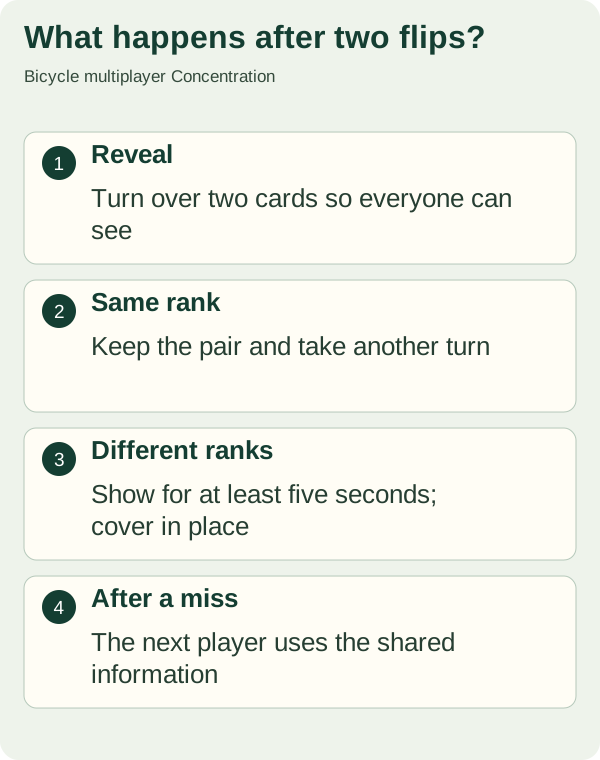
- If their ranks match, take both into your captured pile and attempt another pair.
- If they do not match, let everyone see them for at least five seconds, then turn both face down in exactly the same places. Your turn ends.
A successful match keeps the same player playing, so one turn can capture several pairs. A failed attempt ends it immediately. You cannot leave a useful unmatched card face up, exchange it for a third card, or move it closer to another remembered card. Display the two faces clearly before collecting a match too, so the group can check what happened.
A worked turn using remembered information
Imagine four positions called A, B, C and D. Earlier turns showed a nine at A and a five at B. On the next player's attempt, C reveals another nine and D reveals a king. C and D stay visible for the required pause, then both are covered and play passes.
If you play next and remember A, reveal A and C. Their nines form a pair, so collect them and continue. B's five is still useful information, but it does not give you a guaranteed next pair. You might reveal an unknown position first. If that card is another five, B supplies a known second choice. If it is a different rank, you must make your second choice using the information actually available. You do not get to put the first card back and start again.
Count pairs and check the end of the game
Continue until every card has been matched. A complete 52-card game produces 26 pairs. Keep each captured pair together, or count captured cards and divide by two. If the combined score is not 26, check the table and captured piles before announcing a result.
For example, three players finishing with ten, nine and seven pairs have accounted for all 26; the player with ten wins. They do not need more than half the pairs. Two players can finish 13-13. Bicycle names the player with the most pairs as winner but does not specify a tie-break procedure. A simple pre-agreed house convention is to share a tied win, or start a fresh game. Do not quietly invent a last-pair bonus to break the tie after the result is known.
Avoid common mistakes and choose another game
If a card is bumped, restore its position openly instead of using the accident to rearrange the board. If more than two cards are exposed by mistake, stop and agree how to restore a fair layout; Bicycle does not prescribe a special penalty. A beginner's error should not be presented as permission for someone to claim an unearned pair.
Remember three checks: same rank, two cards per attempt, and an extra attempt only after a match. Suits carry no special points, captured cards stay out, and no one draws replacements. For a different use of an ordinary pack, compare the shedding rules of Mau Mau. For shared-table combinations instead of position memory, try Machiavelli. Use the card game finder to compare deck and group requirements.
Rule references and corrections
This independent explanation uses the references below. Follow the instructions for the edition you own and agree on house rules before play.
Found a mistake? Send a correction with the game name and source.
A few useful answers
Questions before you deal
Do Memory pairs have to match suit or color?
No. In Bicycle's standard-deck Concentration rules, two cards of the same rank make a pair regardless of suit or color.
Do you get another turn after finding a pair?
Yes. Collect the pair and attempt another. Continue until an attempt fails or all cards have been matched.
How long do unmatched cards stay visible?
Bicycle specifies a pause of at least five seconds. Then turn both cards face down in exactly the same positions and pass to the player on the left.
How many pairs are in a full game, and can players tie?
The 52 cards make 26 pairs. A tie for the highest pair count is possible. Bicycle does not give a tie-break rule; agree beforehand whether to share the win or play again.
Keep exploring M card games
Compare all card games that start with M, or use the card game finder for your group.